Engineering
Sustainable Solutions
Specialized steam boiler consultancy and turnkey project management for Southeast Asia's industrial sector. Engineered for reliability, sustained by thermal expertise.
SELANGOR
Core Capabilities
[ Specialized Operations ]Boiler Design & Engineering
Complete design solutions from detailed engineering to handover, including integration of modern control systems for reliable steam generation.
Installation Supervision
On-site contractor engagement, safety briefings, and schedule control to ensure quality execution and full regulatory compliance.
Commissioning & Handover
Coordinating instrumentation suppliers such as Yokogawa and Siemens, ensuring smooth commissioning and performance validation.
Maintenance & Lifecycle Management
Preventive and corrective maintenance, refurbishment, and targeted upgrades that extend boiler life while improving safety, efficiency, and emission performance.
Energy Audits & Optimization
Efficiency studies, waste heat and condensate recovery, combustion tuning, and fuel-switching assessments to reduce fuel use, emissions, and operating cost.
Project Management
End-to-end management of fabrication, installation, and commissioning, including vendor evaluation and risk or cost analysis.
Boiler Health & Compliance Assessment
Practical site walk-downs, log-book review, and instrumentation checks for small-scale boiler operators. Independent reports aligned with JKKP/DOSH and BS 1113 expectations, with vendor-neutral recommendations to close compliance gaps.
Typical Water Tube Biomass Boiler Specifications
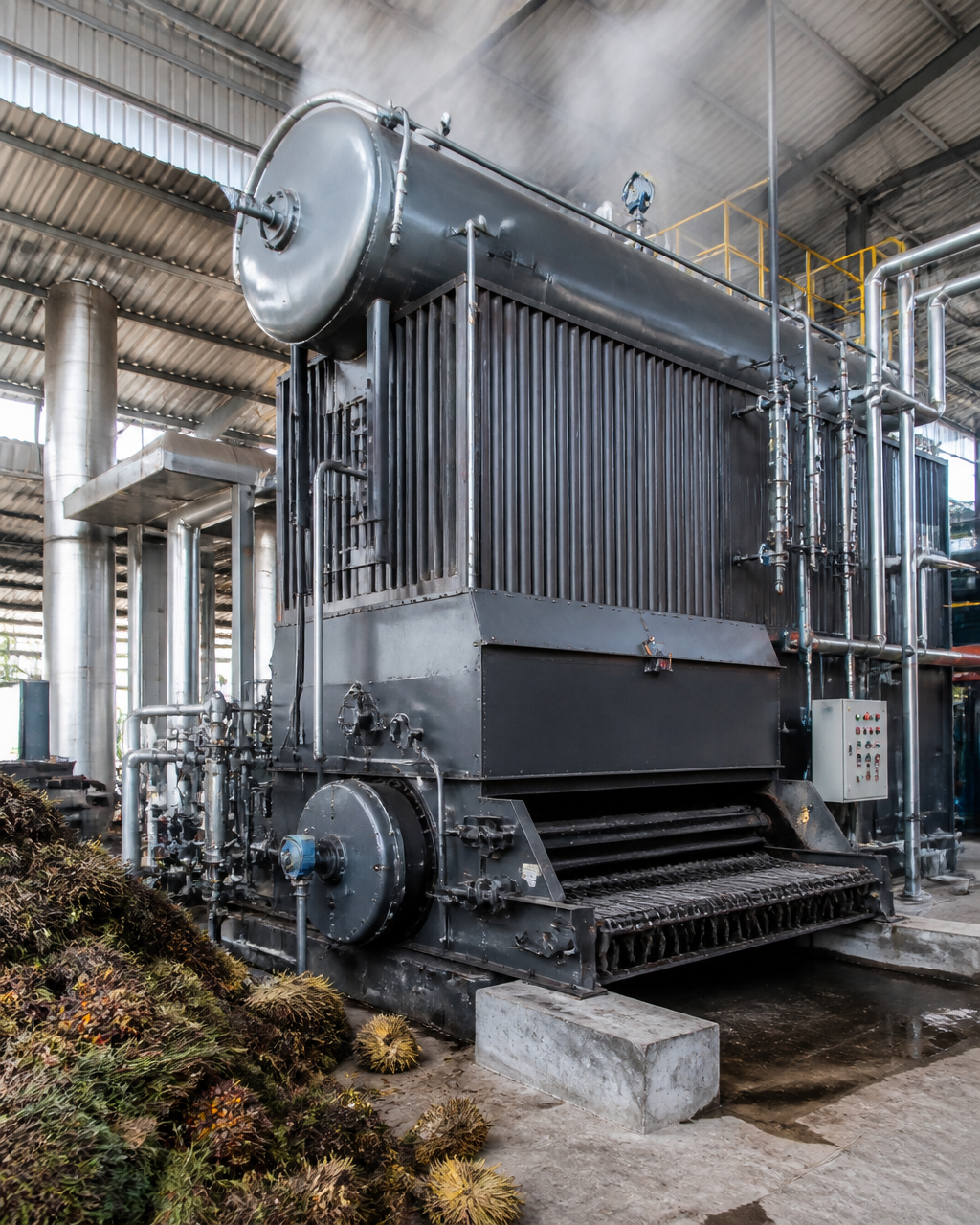
[ Malaysian Palm Oil Mill Reference ]Specifications are representative of water tube biomass boilers commonly supplied to Malaysian and Indonesian palm oil mills, including installations built to Mechmar and Petra-equivalent standards. Exact ratings depend on site steam demand, fuel analysis, and statutory requirements.
Codes, Standards & Statutory Requirements
[ Malaysia Compliance ]BS 1113 & Equivalent Design Codes
Water tube boilers supplied and engineered for Malaysian industry are generally designed and fabricated to BS 1113 (Specification for water-tube steam generating plant), ASME Section I, or equivalent internationally recognised pressure-vessel codes. These govern material selection, weld procedures, hydrostatic testing, safety margins, and non-destructive examination.
- >Design pressure and temperature ratings
- >Stress analysis and fatigue life assessment
- >Welding qualifications and NDT acceptance criteria
- >Hydrostatic test and performance guarantee protocols
JKKP / DOSH — Factories & Machinery Act 1967
Steam boilers in Malaysia fall under the Department of Occupational Safety and Health (DOSH), formerly JKKP. The Factories and Machinery Act 1967 (Act 139) and the Steam Boiler and Unfired Pressure Vessel Regulations require registration, periodic inspection, and operation by competent persons.
- >Design approval and fabrication inspection by DOSH-authorised inspectors
- >Annual thorough examination of steam boilers and safety valves
- >Competent Person (Boiler) certification for operation
- >Incident reporting and statutory record keeping
DOE — Environmental Quality Act 1974
Biomass boiler emissions are regulated by the Department of Environment (DOE) under the Environmental Quality Act 1974. Palm oil mills, refineries, and biomass power plants must comply with prescribed emission limits for particulates, sulphur oxides, nitrogen oxides, and opacity.
- >Stack emission monitoring and reporting
- >Dust collection, multicyclone, and bag filter systems
- >Fuel handling and ash disposal compliance
- >Environmental Impact Assessment (EIA) where applicable
How Agnitherm Supports Compliance
We align every boiler project with the applicable design code and Malaysian statutory framework from concept to handover. Our scope includes liaison with DOSH-authorised inspectors, preparation of technical documentation, and integration of emission control systems to meet DOE requirements.
- >Technical file preparation for DOSH design approval
- >Inspection and test plan (ITP) coordination
- >Emission control system specification and sizing
- >Handover documentation and operator training
Note: Statutory interpretation can evolve. Agnitherm works alongside DOSH, DOE, and appointed inspectors to ensure each project meets the current regulatory position. The above is provided as general guidance and should be confirmed against the latest official instruments for your specific installation.
ESG & Boiler Life Extension
Where replacement is not immediately practical, Agnitherm helps mill operators extend boiler life through targeted efficiency, emission, and safety improvements aligned with modern ESG expectations.
- >Combustion tuning and heat recovery
- >Emission control and DOE compliance support
- >Biomass co-firing and fuel optimisation
- >Safety interlock and DOSH recertification support
Detailed methodology, instrumentation, and commercial terms are discussed under confidentiality.
Project Development & Engineering Services
- 01 Steam boiler revamps and refurbishment for palm oil mills and refineries.
- 02 Project management services for waste-to-energy and renewable energy projects.
- 03 Heavy machinery and quarry/mining plant repair, maintenance and operations services.
- 04 Process facilities building maintenance and repair services.
- 05 Technology partner sourcing and JV facilitation services.
The Agnitherm
Protocol
Engineering is not about opinion; it is about measurable thermal equilibrium and disciplined execution.
Assessment & Loading Analysis
We calculate peak steam demand and redundancy requirements based on your manufacturing outputs, operational hours, and growth plans.
Technical Specification
Detailed P&ID drawings, equipment schedules, and vendor shortlists are developed to ensure long-term serviceability and compliance.
Execution & Commissioning
On-site management during fabrication, installation, and the critical startup phase, followed by rigorous performance verification.